Pakistan–France Partnership Spotlighted at Post-COP30 Forum in Islamabad
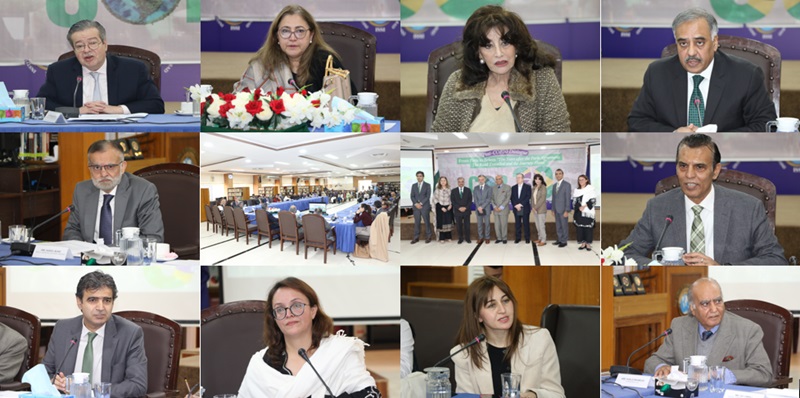
Islamabad (NNP) The Institute of Strategic Studies Islamabad (ISSI), in collaboration with the Civil Society Coalition for Climate Change (CSCCC) and supported by the Embassy of France in Pakistan, hosted a high-level Post-COP30 Dialogue on Wednesday titled “From Paris to Belem Ten Years After the Paris Agreement: The Road Travelled and the Journey Ahead.” The event brought together senior government officials, diplomats, policy experts and development partners to assess global climate action a decade after the Paris Agreement and to reflect on Pakistan’s national trajectory.
The panel of distinguished speakers included Secretary of Climate Change & Environmental Coordination Ms. Aisha Humera Moriani; French Ambassador to Pakistan H.E. Nicolas Galey; Special Secretary (UN) Ambassador Nabeel Munir; CSCCC Chief Executive Ms. Aisha Khan; SDPI Executive Director Dr. Abid Suleri; and Asian Development Bank Senior Climate Change Officer Mr. Hiz Jamali.
Opening the dialogue, Dr. Neelum Nigar welcomed participants and described the gathering as an important moment to evaluate a decade of climate efforts and the escalating challenges faced by vulnerable countries like Pakistan. She noted that outcomes from COP30 underscore the need for long-term commitment, informed policymaking and stronger cooperation.
In his welcome remarks, ISSI Director General Ambassador Sohail Mahmood said the discussions in Belem took place against a backdrop of heightened geopolitical strain and widening divides in global climate negotiations. He highlighted persistent gaps between ambition and delivery, particularly on climate finance and the operationalisation of the Loss and Damage Fund. Despite contributing less than one percent to global emissions, he said, Pakistan remains among the world’s most climate-vulnerable countries—an exposure evident in repeated floods, glacial melt and extreme heat events. He urged the international community to ensure predictable, grant-based financing for climate-vulnerable states.
CSCCC’s Aisha Khan underscored the need to centre Pakistan’s climate narrative on equity, data and preparedness. She said that ten years after the Paris Agreement, the world stands at a “critical inflection point” where progress cannot be measured without acknowledging the gaps in political will, delivery mechanisms and global ambition. She welcomed the shift to a post-COP review format, calling reflection and honest appraisal essential for shaping Pakistan’s position ahead of COP31.
Delivering the keynote address, Secretary MoCC Ms. Aisha Humera Moriani described COP30 as an “implementation COP,” stressing that Pakistan’s submission of its more ambitious NDC 3.0 reflects extensive national consultations and long-term planning until 2035. She argued that the global climate challenge stems not from insufficient pledges, but from gaps in the means of implementation—finance, technology transfer and capacity-building. She reiterated that adaptation financing must be grant-based, warning that borrowing for resilience would push vulnerable states deeper into debt. While welcoming the operationalisation of the Loss and Damage Fund, she called for its substantial capitalisation and simplified access for countries like Pakistan.
French Ambassador Nicolas Galey, speaking as Guest of Honour, noted that the world marks the tenth anniversary of the Paris Agreement at a time when scientific consensus and collective commitment are increasingly fractured. With the 1.5°C threshold already crossed in 2024, he cautioned that climate impacts are intensifying globally, including in Pakistan where floods and heatwaves have become more frequent and severe. Despite this dire outlook, he reaffirmed France’s commitment to ecological transition and climate justice, highlighting its legal pledge to achieve carbon neutrality by 2050 and its provision of over €6 billion annually in climate finance. He acknowledged ongoing partnerships in Pakistan, particularly those supporting gender-responsive climate initiatives.
Offering a strategic overview of COP30, Ambassador Nabeel Munir said the conference laid bare growing divides in global climate politics and, for the first time, formally acknowledged the possibility of a temperature overshoot. He welcomed the commitment to triple adaptation finance by 2035 but pointed to gaps in baseline definitions and implementation timelines. Citing Pakistan’s ambitious target of a 50% emissions reduction pathway by 2035, he argued that such ambition is unsustainable without accessible finance and affordable technology.
During the panel discussion, SDPI’s Dr. Abid Suleri situated COP30 within the broader evolution from Kyoto to Paris and now Belem, noting that developing countries have demonstrated willingness to reduce emissions, yet progress remains slow due to insufficient climate finance and geopolitical polarisation. He called for stronger district-level climate governance and the formation of a regional “coalition of the willing” in South Asia to address shared ecological challenges.
ADB’s Mr. Hiz Jamali added a financial perspective, observing that implementation—rather than funding availability—is often the key barrier. Slow disbursement processes and weak project execution systems, he said, limit the effective use of climate financing. He highlighted the growing role of blended finance and private-sector mobilisation, emphasizing that strong project design, execution capacity and transparent monitoring are essential for Pakistan to attract larger climate investments.
The dialogue concluded with an interactive session focused on strengthening Pakistan’s domestic capacity amid an increasingly complex global climate governance environment. Speakers agreed that the 10th anniversary of the Paris Agreement represents not only a moment for reflection but also an opportunity for renewed ambition, deeper institutional cooperation and sustained diplomacy.
Ambassador Khalid Mahmood, Chairman of ISSI’s Board of Governors, delivered the vote of thanks and presented mementos to the speakers and participants, marking the close of the event.