Leaders, Economists Call for Pro-People Reforms, Fair Taxation and Empowered Local Governments to Drive Sustainable Growth
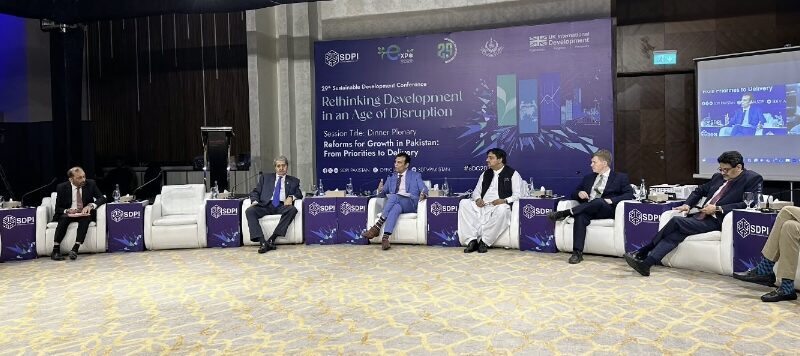
ISLAMABAD, November 6, 2026: Pakistan’s political leaders, former ministers and leading economic experts have called for comprehensive governance reforms, progressive taxation, empowered local governments and improved public service delivery to achieve sustainable, inclusive and equitable economic growth.The call came during a high-level dialogue titled “Reforms for Growth in Pakistan: From Priorities to Delivery,” held as part of the 29th Sustainable Development Conference, organised by the Sustainable Development Policy Institute (SDPI) in collaboration with the Foreign, Commonwealth and Development Office (FCDO).Punjab Assembly Speaker Malik Muhammad Ahmad Khan stressed that meaningful reforms must begin with respect for the Constitution, the rule of law and the authority of elected representatives. He observed that unpredictable governance, political victimisation and excessive regulation were discouraging investment, while education and public services continued to face neglect.
Syed Naveed Qamar, Chairman of the National Assembly Standing Committee on Finance and Revenue, emphasised the need to combine fiscal discipline with political consensus and meaningful consultation. He highlighted mounting expenditure pressures, debt servicing and the narrow tax base, questioning why the Council of Common Interests (CCI) was not being utilised more effectively to address federal and provincial issues.Dr Farooq Sattar, Chairman of the National Assembly Standing Committee on Privatization, said the 18th Constitutional Amendment and National Finance Commission (NFC) Award had strengthened provincial governments without ensuring a corresponding transfer of powers and resources to districts. He advocated elected and financially empowered local governments, predictable district allocations and greater grassroots participation in economic planning.Former finance minister and Secretary-General of the Awaam Pakistan Party, Dr Miftah Ismail, underlined the importance of improving education, healthcare and the quality of provincial expenditure. He also called for reconsidering electricity pricing structures and stressed that reducing fiscal and external deficits while strengthening exports was essential to ending Pakistan’s recurring dependence on IMF programmes.Former federal minister Engr. Khurram Dastagir Khan highlighted the challenges confronting manufacturers in industrial centres such as Gujranwala, including excessive taxation, expensive electricity and gas, and complicated regulatory requirements. He called for greater use of technology, transparency and competition to improve the business environment and eliminate monopolistic practices.Former finance minister Asad Umar said sustainable economic growth and an end to repeated IMF programmes would require lower fiscal deficits and an export-oriented economy. He stressed that an effective state must ensure that responsibility, authority and accountability remain aligned.Former federal minister for maritime affairs Syed Ali Haider Zaidi argued that increasing tax rates alone could not resolve Pakistan’s economic challenges. He called for controlling government expenditure, eliminating institutional inefficiencies, reforming the administrative system and strengthening justice, accountability and investment in human development.
Muzzammil Aslam, former adviser to the Khyber Pakhtunkhwa chief minister on finance, identified tax exemptions in property, agriculture and other sectors as major obstacles to expanding revenue collection. Referring to provincial reforms, he said Khyber Pakhtunkhwa had increased its own-source revenue from approximately Rs65 billion to Rs150 billion while reducing rates and promoting digital transactions.Former finance minister Prof. Dr Hafiz Ahmed Pasha called for comprehensive and progressive taxation, observing that salaried employees and large-scale manufacturers carried a disproportionate tax burden, while property, retail, wholesale trade and agricultural incomes remained undertaxed. He estimated that a more equitable tax system could generate an additional 3 to 3.5 per cent of GDP, creating fiscal space for development expenditure and reducing government borrowing.Dr Kaiser Bengali, former adviser to the Sindh chief minister, identified budgetary imbalances, trade deficits and debt financing as major structural weaknesses in Pakistan’s economy. He called for reducing non-development expenditure, eliminating duplicative federal ministries and departments, and curbing government borrowing that restricts credit availability for businesses.Ahmad Iqbal Chaudhary, Chairman of the Public Accounts Committee of the Punjab Assembly, stressed that economic growth should be assessed not only through national indicators but also through the performance of provinces, cities and districts.
He called for reliable fiscal transfers to local governments, stronger accountability and greater citizen participation in decisions concerning everyday needs and public services.Former Special Secretary Finance Noor Mohammed highlighted how excessive government demands on limited financial resources were restricting liquidity for private-sector investment. He emphasised the need to improve public spending efficiency, eliminate institutional duplication and reform the civil service.Former Chairman of Punjab’s Planning and Development Board Suleman Ghani called on political parties to develop a 20-to-30-year national vision for economic governance. He stressed that decision-making and service delivery responsibilities should be transferred closer to citizens, enabling local governments to effectively manage primary education, healthcare and other essential services.Abdul Ghufran Memon, Member of the Sindh Public Service Commission, highlighted the longstanding backlog of audit observations and weaknesses in follow-up mechanisms through Public Accounts Committees. He called for timely decisions on pending cases, stronger implementation mechanisms and sustained political consensus on key reform programmes.Dr Vaqar Ahmed, Team Lead at OPM Pakistan, advocated measurable regulatory reforms to reduce compliance costs for businesses. He proposed temporarily restricting the introduction of overlapping regulations while existing rules are reviewed, conducting annual assessments of regulatory performance and improving institutional coordination before launching additional digital platforms.
Senior journalist Fahd Husain questioned whether established political, administrative, commercial and media interests had sufficient incentives to support reforms that could challenge existing arrangements.Senior journalist Zebunisa Burki stressed that the success of economic reforms should be measured from the perspective of ordinary citizens rather than through headline growth figures or infrastructure announcements alone.The dialogue highlighted the need for a comprehensive reform agenda centred on fair taxation, institutional accountability, decentralisation, efficient public expenditure and citizen-oriented governance to put Pakistan on a sustainable path to economic growth.