Exports Need Systems That Work, Not Promises That Repeat
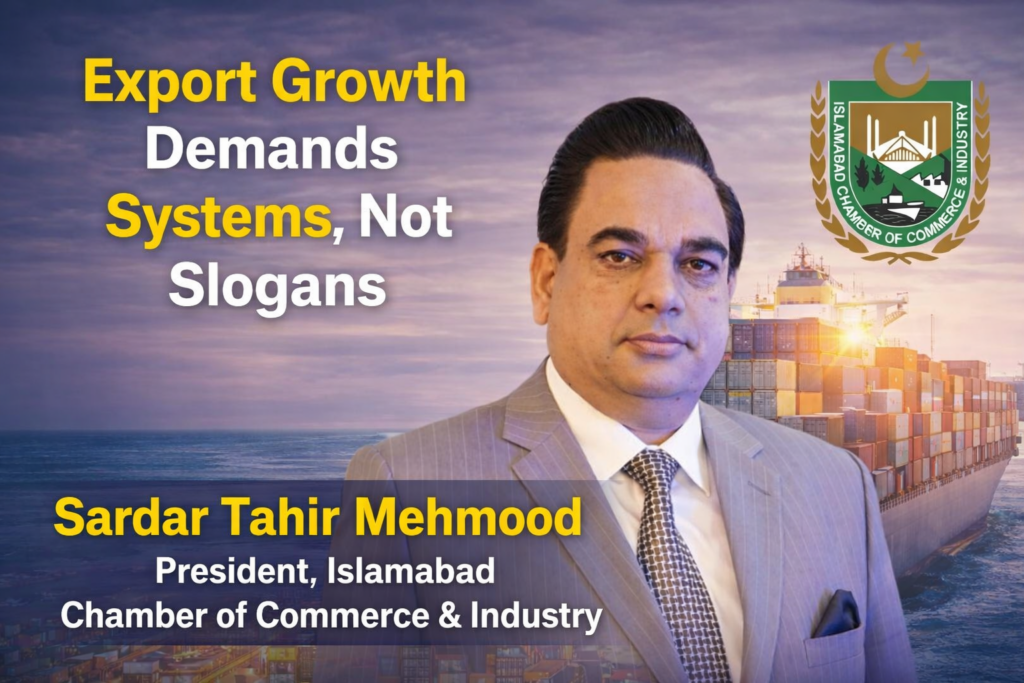
By Sardar Tahir Mehmood President, Islamabad Chamber of Commerce & Industry (ICCI)
Pakistan’s export challenge is often misunderstood. It is not rooted in a lack of global demand, nor in the absence of capable entrepreneurs. Pakistani exporters continue to compete internationally, secure buyers, and build markets—often under far more competitive conditions than many of their regional peers.
The real constraint lies elsewhere.
Exports function on three non-negotiable: time, reliability, and trust. In today’s interconnected global supply chains, even minor delays can have major consequences. Unfortunately, within Pakistan, exporters must navigate unpredictable procedures, discretionary clearances, and liquidity constraints that delay execution—even where no tax or duty is involved.
This disconnect between policy intent and operational reality carries a cost. International buyers plan their sourcing around certainty. When shipments are delayed or documentation timelines remain unclear, confidence erodes. Over time, orders quietly shift to markets where delivery is predictable and systems are aligned with trade facilitation.
What Pakistan requires at this stage is not another policy announcement or isolated notification, but a systemic reset—one that aligns export facilitation with trade growth rather than revenue enforcement. Exports are zero-rated by design; they should therefore be managed through frameworks that prioritize speed, predictability, and post-clearance risk management.
A National Export Emergency would not weaken oversight or compliance. On the contrary, it would strengthen outcomes by introducing time-bound processes, digital transparency, and risk-based controls that focus on genuine risk rather than routine obstruction. Such an approach would improve foreign exchange realization, enhance Pakistan’s credibility as a supplier, and restore exporter confidence.Exports are not a privilege extended to a few sectors; they are a national economic necessity. Sustainable foreign exchange inflows, currency stability, industrial employment, and long-term growth all depend on a system that enables exporters to deliver on time.
If Pakistan seeks durable economic recovery, it must treat exporters as partners in growth, not obstacles to manage. Systems that work will always deliver more than promises that repeat.
Sardar Tahir Mehmood is President of the Islamabad Chamber of Commerce & Industry (ICCI) and a long-time advocate for export-led economic growth.