
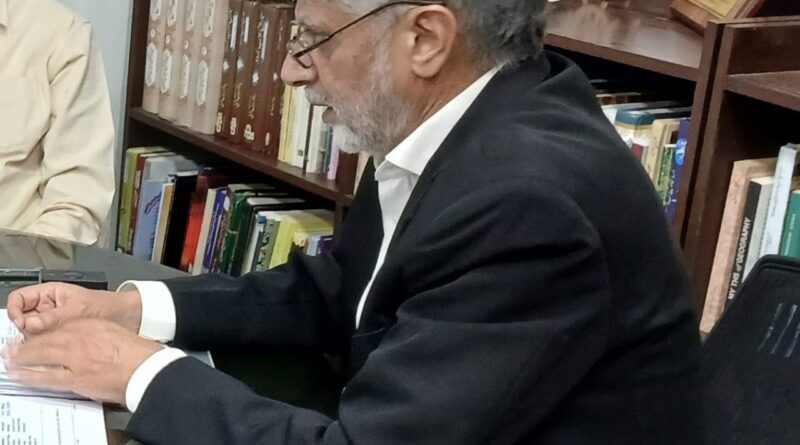
Dr Hamdani calls for values-driven Islamic economics in Pakistan
ISLAMABAD: Pakistan’s transition towards a riba-free economic system will remain incomplete unless universities move beyond technical financial reforms and provide clear ethical and intellectual direction, participants at a national academic conference argued.Prof. Dr Syed Nisar Hamdani, presiding over a key session of the conference at Quaid-i-Azam University, urged Pakistani universities to assume a leading role in developing Islamic economics as a coherent academic and policy framework, maintaining that the country’s economic transformation requires a shift in purpose rather than merely a change in instruments.He said that while Islamic banking and finance were expanding rapidly worldwide, Pakistan continued to lag in meaningful academic innovation. Most domestic efforts, he noted, remained narrowly focused on financial products, with limited attention to the broader Islamisation of the economy necessary for genuinely Shariah-compliant systems
Dr Hamdani argued that the future of Islamic economics would not be shaped by new contracts or financial structures, but by clearly defined economic objectives. Beyond 2028, he said, the real transition facing Pakistan was not simply from interest-based to non-interest-based arrangements, but from value-neutral economics to values-guided development grounded in ethical principles. “If the direction is right, the tools will follow,” he remarked.Quoting former State Bank of Pakistan managing director Qasim Nawaz, Dr Hamdani said Islamic banking could only mature meaningfully when embedded within a comprehensive Islamic economic framework rather than operating as an isolated financial segment.Emphasising the role of higher education, he urged universities to move beyond producing technically skilled graduates and instead nurture students with an ethical and moral perspective on economics and development. He stressed the importance of self-development and character-building, arguing that economic systems ultimately reflect the values of those who design and manage them.He also highlighted the need for stronger academic foundations, urging universities to offer at least a three-credit-hour course in Philosophy for MPhil and PhD scholars to foster critical thinking and theoretical understanding in Islamic economics.Dr Hamdani expressed concern over the limited volume of need-based research in Islamic economics in Pakistan despite the country’s Muslim-majority status. He attributed this gap to weak institutional initiative and the absence of clear academic direction aligned with national needs.Referring to the Supreme Court’s directive on the implementation of a riba-free economy after January 2026, Dr Hamdani said universities had so far shown a limited and unstructured response. He called for the establishment and strengthening of dedicated departments of Islamic economics and banking, expanded interdisciplinary research, and systematic student training to meet growing national and international demand.He appreciated the School of Economics at QAU and acknowledged the contributions of Dr Javed, Prof Dr Anwar Shah, Dr Tariq Majeed, Dr Fatimiah and other faculty members in organising the conference.The conference brought together economists, academics and researchers from across the country.
Looking for a reliable Sv388 link? Sv388link seems legit. Got me where I needed to go without any hassle. If you need it, here it is: sv388link
Hey gamers, wanted to share my experience with lc88win. I’ve been playing here for a bit and the payouts have been legit. Plus, the variety of games keeps things interesting. Check them out at lc88win.
BJ88login on .org. Easy peasy login- what more you want? I found it nice and straightforward. Have a peek. bj88login
Trying to log in to Jollibet? jollibetcasinologin might be what you’re looking for. Quick and easy access. Give it a shot! Here’s where to go: jollibetcasinologin