
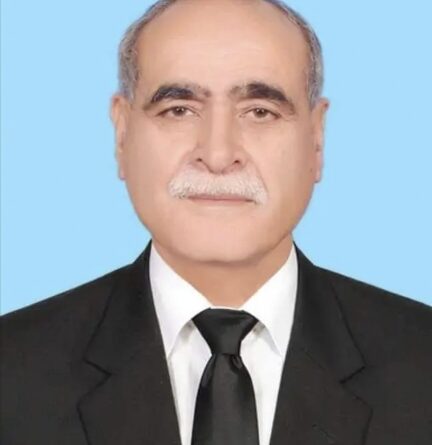
Colonel Khan Muhammad Khan Multi- Dimensional Lead For Youth
A Glorious Legacy of the Kashmir Freedom Movement, Educational Renaissance and National Service
Special Feature on the 65th Death Anniversary – November 11, 2026
History accords enduring respect to those individuals who rise above personal interests and devote their lives to the service of their people, homeland and society. Colonel Khan Muhammad Khan, popularly known as Khan Sahib and revered as Baba-e-Poonch, stands among the distinguished personalities of the State of Jammu and Kashmir whose political vision, military experience, educational contributions and social reforms left an indelible mark on the region’s history.Khan Sahib was not merely a political leader or a freedom movement activist. He was a multifaceted national figure, a social reformer and a visionary educationist whose life was defined by public service, collective welfare and the promotion of social awareness. In recognition of his extraordinary educational contributions, he is also remembered as the Sir Syed Ahmad Khan of Poonch.Born in 1882 in Chhe Chhan village of present-day Sudhanoti district, now known as Khanabad, he joined the British Indian Army in 1902 after completing his early education. He participated in the First World War and rendered distinguished military service. Following his retirement from the army, he devoted his abilities, experience and energies to public welfare and social transformation.Education: The Central Mission of His LifeThe most remarkable dimension of Khan Sahib’s personality was his extraordinary commitment to education. During his time, the people of Poonch and Sudhanoti were confronted with widespread poverty, illiteracy and a severe shortage of educational opportunities.
Recognising education as the foundation of social transformation and national progress, he established the Sudhan Educational Conference and launched an organised movement to spread awareness about the importance of learning.His famous Muthi Bhar Atta (a handful of flour) initiative was an innovative and exemplary model of community participation in education. Under this scheme, small quantities of flour were collected from households, and the resources generated through this collective effort were utilised to support the education of poor and deserving children and establish educational institutions.This was far more than a financial arrangement. It represented a remarkable culture of public participation, shared responsibility and commitment to education. Through this initiative, Khan Sahib transformed education from an individual aspiration into a collective social responsibility and laid the foundations of an educational awakening throughout the region.He also attached particular importance to female education. The establishment of a school for girls at Chhe Chhan on November 17, 1939, was a significant achievement in the prevailing social environment. His educational movement opened new avenues of knowledge and awareness for generations to come. His contribution remains an integral part of the educational identity of Poonch and Sudhanoti.Religious Education and the Establishment of Dar-ul-Uloom Taleem-ul-Quran, PalandriAn equally important dimension of Khan Sahib’s educational philosophy was the promotion of religious learning. He believed that the development of a balanced and enlightened society required not only modern education but also religious knowledge, moral training and the promotion of Islamic values.It was through his initiative and patronage that the foundation of Dar-ul-Uloom Taleem-ul-Quran was laid in Palandri. He was also supported in this noble undertaking by the prominent political personality of that period, Sardar Feroz Ali Khan.The responsibility of establishing and developing this religious institution was entrusted to the late Maulana Yousaf Khan, a distinguished scholar and graduate of Dar-ul-Uloom Deoband. Under his leadership, the institution gradually developed into an important centre of Islamic learning and religious education.
Today, hundreds of scholars graduating from Dar-ul-Uloom Taleem-ul-Quran, Palandri, are serving in the judicial and religious institutions of Azad Jammu and Kashmir, particularly in its Qaza and justice system. Many others are performing religious, educational and social responsibilities through mosques and religious institutions across Pakistan, guiding communities through the teachings of Islam and contributing to moral and social reform.The institution is a practical manifestation of Khan Sahib’s far-sighted vision that the development of society must rest upon a combination of contemporary education, religious knowledge, ethical values and character building. The services of the late Maulana Yousaf Khan and the scholarly contributions of subsequent generations have carried this mission forward.Continuation of the Educational Mission: The Roots System of EducationThe educational legacy initiated by Khan Sahib also finds a meaningful continuation in subsequent generations of his family.Retired Colonel Mushtaq Khan and his wife, Mrs Riffat Mushtaq, granddaughter of Khan Sahib and daughter of the late Colonel Retired Naqi Khan, played a prominent role in the establishment and development of the Roots System of Education.Their sons are also contributing to the administration and educational activities of this renowned educational network, carrying forward its institutional development and academic objectives.This continuity reflects an important historical reality: the educational consciousness and sense of collective responsibility cultivated by Khan Sahib did not remain confined to his own lifetime. His descendants also embraced education as a practical priority and continued to contribute to its advancement.While Dar-ul-Uloom Taleem-ul-Quran, Palandri, has served as a centre for religious learning and the promotion of Islamic values, the Roots System of Education represents the family’s contribution to quality education in accordance with contemporary requirements. Together, these institutions reflect different yet complementary dimensions of the broad educational vision associated with Khan Sahib.Defence of the Homeland, Military Traditions and National ServiceAnother significant aspect of Khan Sahib’s personality was his military background and commitment to the defence of the homeland. His long service in the British Indian Army, participation in the First World War and rise to the rank of Colonel reflected his discipline, courage, leadership and military professionalism.
These qualities and experiences subsequently became valuable assets during the Kashmir freedom movement. His understanding of military organisation, strategic thinking and leadership enabled him to make a meaningful contribution during a critical period in the history of the region.The tradition of military service and national commitment also continued in subsequent generations of his family. General Muhammad Aziz Khan, who hails from Palandri, holds a distinguished place in this regard. He rose to the highest levels of Pakistan’s military leadership and served as Chairman Joint Chiefs of Staff Committee from October 7, 2001, to October 6, 2004, a four-star constitutional military appointment that placed him among the country’s senior defence leadership.Similarly, the military services of the late Colonel Retired Naqi Khan and Colonel Retired Mushtaq Khan form part of this family tradition.These contributions demonstrate how the values of discipline, national consciousness and service to the homeland embraced by Khan Sahib continued to influence subsequent generations.His legacy, therefore, extends beyond education and politics. It also represents a distinguished tradition of military leadership, national service, defence of the homeland and character building. It reminds us that education and national defence are equally essential pillars of a nation’s strength and development.Political Leadership and the Kashmir Freedom MovementKhan Sahib’s contribution to the political life of the State of Jammu and Kashmir was equally significant. In 1934, he won election to the State Legislative Assembly, representing the people of Bagh and Sudhanoti. Until 1946, he continued to raise the voice of his constituency and advocate the interests of his people.A notable example of his political maturity and generosity was his decision in 1946 to support Barrister Sardar Muhammad Ibrahim Khan for the Assembly seat, reflecting his ability to place broader national objectives above personal political considerations.When the Kashmir freedom movement entered its decisive phase in 1947, Khan Sahib, despite his advancing age, actively participated in the struggle. He was entrusted with the responsibility of heading the War Council and was subsequently included in the Defence Council.His military experience, organisational abilities, political influence and extensive public connections proved valuable during this critical period. He emerged as one of the important figures associated with the political and organisational dimensions of the freedom struggle.On November 11, 1961, this distinguished personality passed away, leaving behind a legacy of courage, public service, educational enlightenment and national commitment. His people continue to remember him with reverence as Baba-e-Poonch and Sir Syed of Poonch.His Historical Legacy and the Responsibilities of the Present GenerationThe true recognition of a great personality lies not merely in the achievements of his own lifetime but also in the lasting influence of his ideals upon subsequent generations and national life.In this context, a remarkable historical connection is that Dr Muhammad Najeeb Naqi, grandson of Colonel Khan Muhammad Khan, is today serving as the President of Azad Jammu and Kashmir. His election to this prestigious constitutional office and subsequent oath-taking in September 2026 represent an important chapter in the family’s public and political history.This position carries significant constitutional responsibilities. However, the true distinction of this historical association will be reflected in the extent to which the educational, social and national traditions of his illustrious grandfather are carried forward. For Dr Najeeb Naqi, it is an opportunity to strengthen the legacy of public welfare, educational advancement and national cohesion while upholding the dignity of his constitutional office.Today, the region of Poonch and Sudhanoti is confronted with a different set of challenges. Recent protest movements, political tensions, road blockages and law-and-order difficulties have adversely affected public life, business activities, educational institutions and government functions.Against the backdrop of protests associated with the Joint Awami Action Committee, which authorities have declared proscribed, another unfortunate development is that the general electoral process remains incomplete in seven constituencies of Poonch and Sudhanoti.Under these circumstances, the restoration of peace, public confidence, democratic activities and administrative continuity has become imperative. The newly elected President of Azad Jammu and Kashmir, Dr Muhammad Najeeb Naqi, and Prime Minister Barrister Syed Iftikhar Ali Gilani have a particularly important responsibility in this regard.They must utilise their constitutional positions and political influence to understand public concerns, engage meaningfully with all relevant stakeholders and promote dialogue, reconciliation and mutual understanding. Their collective efforts can play a significant role in restoring lasting peace, stability and public confidence in the region.The protection of public rights, provision of essential facilities and accountability of government are legitimate requirements of a democratic society. Equally important are the continuity of law and order, educational activities, business, public mobility and the electoral process. The government must take practical measures to address genuine public grievances and rebuild mutual trust so that Poonch and Sudhanoti can return to the path of education, development, democratic participation and prosperity.This is particularly important when we recall that the very region in which Khan Sahib initiated an educational revolution through his Muthi Bhar Atta scheme, encouraging people to establish schools and educational institutions through collective contributions, is today in need of an environment that provides its younger generation with education, employment, peace and opportunities for progress.The lesson of his life is clear: nations do not advance through confrontation and division but through unity, education, tolerance, collective awareness and constructive engagement.Preserving the Legacy for Future GenerationsThe anniversary of Khan Sahib is not merely an occasion to remember a distinguished national figure; it is also an opportunity for collective introspection and an assessment of our responsibilities towards society.His authentic historical contributions must be documented and preserved for future generations. Educational institutions should introduce students to his life and achievements, while his educational mission should be revived and adapted to contemporary requirements.Indeed, the fundamental dream of Baba-e-Poonch, Colonel Khan Muhammad Khan, was to see Poonch and Sudhanoti emerge as centres of education, awareness, peace, unity, political consciousness and social development. This remained the guiding mission of his entire life.Realising this vision is a shared national and moral responsibility of the Government of Azad Jammu and Kashmir, particularly President Dr Muhammad Najeeb Naqi and Prime Minister Barrister Syed Iftikhar Ali Gilani, as well as his family, relatives and all those who hold his contributions in high regard.The best tribute to his personality would be to translate his ideals into practical initiatives rather than confining his memory to commemorative ceremonies. His message of education, public service, unity and national responsibility must become part of our collective conduct.The true tribute to Baba-e-Poonch, Colonel Khan Muhammad Khan, lies in making his mission of education, service, unity and social responsibility a living reality.
His life reminds us that greatness is not measured by official positions or personal achievements but by the services that illuminate the path for generations to come.The most enduring monuments to great personalities are not merely buildings erected in their names; they are the dreams they leave behind, which succeeding generations must transform into reality through their dedication, character and actions.May Almighty Allah grant the departed soul the highest place in His eternal mercy. Ameen.
