Pakistan Cannot Achieve Progress Without Reforms, Rule of Law, and Sincere Political Leadership, Says Shahid Khaqan Abbasi
Islamabad 15june, President of Awaam Pakistan Party and former Prime Minister Shahid Khaqan Abbasi said that the Federal Budget 2026–27 has failed to address the problems faced by the people. He stressed that the rule of law, political stability, transparent elections, and fundamental reforms are essential for Pakistan to overcome its economic crisis. He added that rising poverty, unemployment, inflation, and the burden of debt have made life increasingly difficult for ordinary citizens, and economic progress is not possible under the current system of governance.
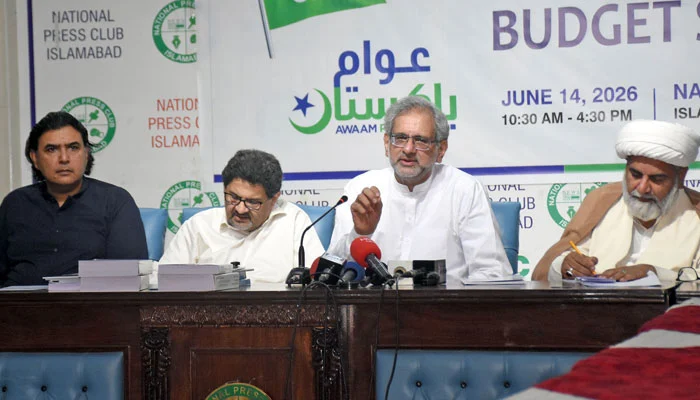
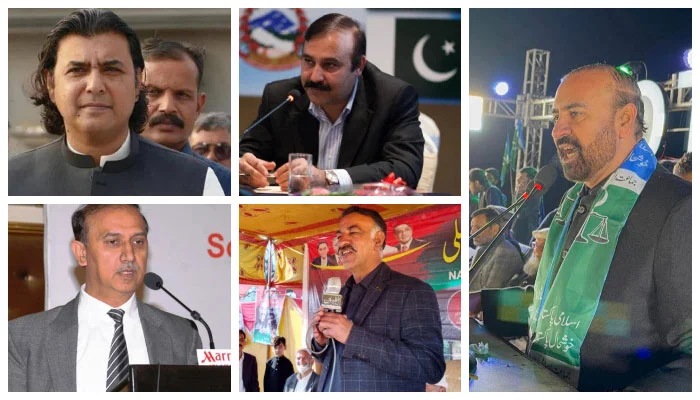
An All-Opposition Seminar on the Federal Budget 2026–27, organized by the Awaam Pakistan Party, was held at the National Press Club Islamabad. The event was attended by leaders of various political parties, economists, representatives of the business community, and members of civil society. Chaudhry Inam Zafar, Central Vice President of Awaam Pakistan Party, congratulated Shahid Khaqan Abbasi, Miftah Ismail, and other opposition leaders on the successful seminar and said that it provided a meaningful platform for discussion on Pakistan’s economic, political, and social challenges.
Addressing the seminar, Shahid Khaqan Abbasi described the budget as meaningless, stating that poverty, unemployment, and inequality continue to rise in Pakistan. He said that progress is impossible without reforms, political stability, the rule of law, and transparent elections. He also raised concerns about the expansion of federal institutions, youth unemployment, increasing pension expenditures, and the existing tax system.
Miftah Ismail, Secretary General of Awaam Pakistan Party, said that poverty, inflation, unemployment, and national debt have increased significantly in recent years, while investment, exports, and industrial growth have failed to improve.He argued that the budget lacks an effective strategy to tackle inflation, poverty, and unemployment, and instead places an additional tax burden on the public.
Allama Raja Nasir Abbas, leader of Tehreek Tahafuz Ayeen-e-Pakistan and Chairman of Majlis Wahdat-e-Muslimeen Pakistan, said that the current budget places further burdens on the public rather than promoting welfare. He emphasized that it is the government’s responsibility to provide healthcare, education, and other essential services in return for the taxes collected from citizens.
Former Speaker of the National Assembly Asad Qaiser said that economic development is impossible without the rule of law, judicial independence, political stability, and investor confidence. He also described the decline of the agricultural sector and restrictions on border trade as harmful to the economy.
Dr. Zafar Mirza, Central Information Secretary of Awaam Pakistan Party, said that Pakistan’s Human Development Index has been declining for the past twelve years. He expressed concern over the growing prevalence of polio, hepatitis, diabetes, mental health disorders, and other public health challenges, urging the government to make healthcare a national priority.
Salman Akram Raja stated that the continuous rise in debt and debt-servicing costs is reducing resources available for development projects, education, and healthcare. He called for greater public investment, constitutional supremacy, stronger local governments, and comprehensive reforms.
Mustafa Nawaz Khokhar said that increasing poverty, inflation, and unemployment are eroding the middle class. He criticized the government for imposing heavy taxes on citizens while failing to provide basic public services.
Muzammil Aslam,Provincial Minister/Advisor for Finance, Khyber Pakhtunkhwa described the federal budget as one designed for specific groups rather than the majority of the population. He called for greater investment in education, healthcare, human development, and pension reforms. Former Member of the Provincial Assembly Taimur Khan Jhagra emphasized the need to expand the tax net, reduce government expenditures, and introduce administrative reforms.
Former Governor of Sindh Muhammad Zubair said that Pakistan requires fundamental reforms, noting that inflation is placing the greatest burden on the poorest segments of society.
Ajmal Baloch, President of the All Pakistan Anjuman-e-Tajiran, said that declining purchasing power among citizens has severely affected businesses and industries. He added that inflation, corruption, and rising government expenditures continue to damage the economy.
Real estate expert Muhammad Ahsan Malik stated that the budget provides no meaningful relief to ordinary citizens while offering tax concessions to the elite and certain privileged sectors. He called for greater consultation with experts in economic policymaking and a fairer taxation system.
The seminar concluded with an interactive question-and-answer session, during which participants exchanged views on the budget and the broader economic challenges facing Pakistan.