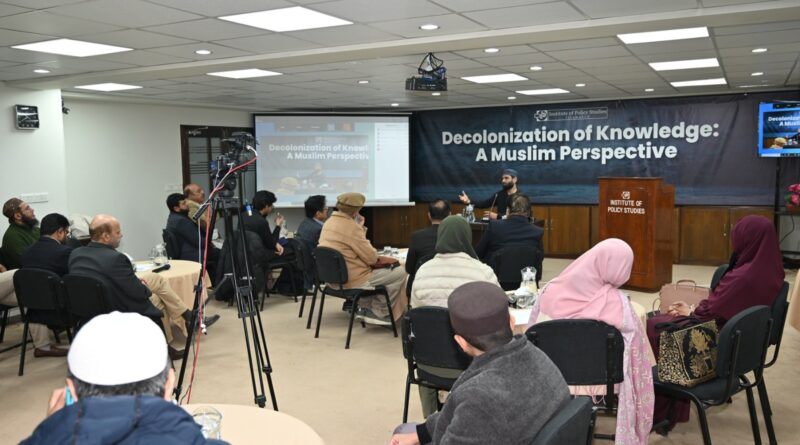
Grounding Modern Thought in Revelation Key to Decolonizing Knowledge: IPS Workshop
Islamabad, January 21: Decolonization of knowledge is not a call to reject modernity or retreat into an imagined pre-colonial past; rather, it is an intellectual project aimed at reclaiming Islamic perspectives by grounding contemporary thought in divine revelation. It engages with the contemporary contexts through the rich, argumentative tradition of Islamic scholarship.
This was emphasized by Dr. Ovamir Anjum, a renowned scholar and the Imam Khattab Chair of Islamic Studies in the Philosophy and Religious Studies Program at the University of Toledo, during an interactive workshop titled ‘Decolonization of knowledge: A Muslim Perspective’ at the Institute of Policy Studies (IPS), Islamabad.The workshop explored conceptual, pedagogical, and institutional dimensions of decolonizing knowledge. It particularly focused on higher education, religious discourse, and intellectual engagement with recently developed paradigms. Academics, researchers, and students from diverse disciplines and backgrounds participated in this in-depth dialogue on how Islamic epistemology can meaningfully interact with contemporary challenges without being subsumed by Western-centric secular frameworks.
Dr. Anjum noted that while colonial legacies continue to shape global knowledge systems, decolonization does not imply disengagement from the present. He argued that Muslims cannot simply “roll back” to a pre-colonial era, as modern values, institutions, and languages are now deeply embedded in lived realities. Instead, he stressed the need to stand firmly within the Ummatic intellectual tradition and move forward, bringing its depth and moral coherence to bear on modern questions.Critiquing prevailing Western decolonial and postmodern approaches, he cautioned that rejecting absolute truth leads to fragmentation and incoherence. In contrast, Islamic decolonization, he explained, must remain anchored in revelation to retain moral clarity and intellectual consistency. He emphasized that the central antagonism in Islam is not class, gender, or power as framed by secular theories but the moral distinction between belief and unbelief, which shapes an entirely different worldview.Addressing concerns about working within “colonized” institutions such as modern universities, Dr. Anjum maintained that no structure is entirely closed to truth. Drawing on the prophetic example, he highlighted how Prophet Muhammad (pbuh) utilized the language, customs, and virtues of pre-Islamic Arabia to convey the message of Tawheed. He added that fitrah, or natural human disposition toward truth, always retains the capacity to reassert itself within any system.On the question of tradition and progress, Dr. Anjum argued that “tradition” is often a modern construct used to marginalize Islamic thought. He noted that the modern narrative of endless progress is itself under strain in the West due to environmental crises and existential threats such as nuclear conflict. In this context, he called for revitalizing internal Islamic dialogue rather than pursuing illusory notions of “pure” authenticity detached from lived historical mediation.The workshop also examined engagement with Western critical theories such as Marxism and feminism. Responding to the scholarly interventions from academics present in the session, Dr. Anjum described dialogue with these frameworks as potentially fruitful, provided Muslims do not abandon the epistemic primacy of revelation. He stressed the importance of maintaining clear boundaries, noting that the Islamic tradition has historically been broad and dialogical while still excluding ideas deemed incompatible with its core principles.Highlighting reforms needed in educational and religious institutions, Dr. Anjum underscored that the Qur’an and Sunnah must not be treated as secondary references or symbolic artifacts. Instead, he called for a return to the classical scholarly method of presenting multiple viewpoints with evidence, fostering intellectual depth rather than using religion for sectarian polemics.In his concluding remarks, Khalid Rahman, chairman of IPS, stressed that the process of decolonization requires a deeper understanding of the aims, objectives, means, and modes of colonialism and imperialism as ongoing processes. He said that IPS shall continue to generate debate and nurture ideas on the subject in collaboration with academic institutions across the world.