
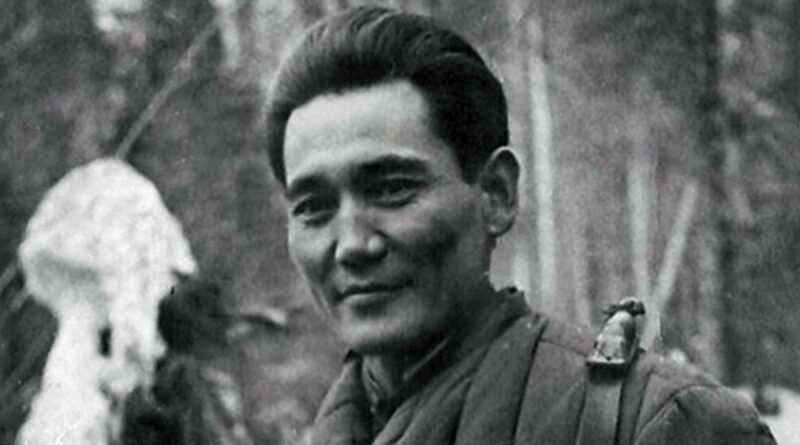
Kazakhstan Marks 115th Anniversary of National Hero Bauyrzhan Momyshuly
Kazakhstan Marks 115th Anniversary of National Hero Bauyrzhan MomyshulyThe Astana Times – Kazakhstan commemorates the 115th anniversary of Bauyrzhan Momyshuly on Dec. 24, honoring the legacy of the legendary commander of the Great Patriotic War, a national hero whose military mastery and literary contributions shaped generations.Born in 1910, Momyshuly rose to become one of the most revered figures in Kazakhstan’s military and cultural history. His life, marked by heroism, discipline, and deep thought, continues to resonate across the nation.✔️Early life: From teacher to soldierBefore becoming a celebrated commander, Momyshuly pursued a wide range of public service roles. After completing nine grades in 1929, he worked as a schoolteacher, district council secretary, head of district police, instructor of the Alma-Ata military commissariat, and later as a prosecutor.His first military service began in 1932 in the Red Army, where he trained as part of the 14th Mountain Rifle Regiment in the Turkistan Military District. Although he was discharged in 1934, he returned to civilian life only briefly.In 1936, as tensions in East Asia escalated, he was called back into service. He joined the 315th Rifle Regiment under Marshal Vasily Blyukher in the Far East, where he successively commanded anti-tank and artillery units. In 1938, he fought bravely against the Japanese Kwantung Army during the Battles at Lake Khasan.✔️Path to MoscowIn 1940, Momyshuly was transferred to the Kiev Military District and then back to Kazakhstan, where he served as a senior instructor. After the outbreak of the Great Patriotic War, he joined the newly formed 316th Rifle Division under General Ivan Panfilov.By June 1941, he was appointed commander of a battalion in the 1073rd Rifle Regiment. After the division’s transfer to the Western Front, Momyshuly rapidly distinguished himself during the construction of defensive lines near Malaya Vishera and the first engagements on the Volokolamsk front.✔️Hero of the battle of MoscowMomyshuly’s tactical brilliance, discipline, and personal courage became the symbol of the Panfilov Division’s resilience. As a battalion commander, he took part in 27 battles during the defense of Moscow.During the second major German offensive in November 1941, his battalion held the line at Matryonino village for three days despite being cut off from the division. His leadership allowed the battalion to break out of encirclement mostly intact, a feat immortalized in Alexander Beck’s renowned book “Volokolamsk Highway”.“Newspapers competed in writing about the phenomenon of Momyshuly, a front-line commander who repeatedly broke out of enemy encirclement with minimal losses,” writer Yelen Alimzhan recalls.In late 1941, General Konstantin Rokossovsky personally appointed him commander of a rifle regiment. Although he was nominated multiple times for the title Hero of the Soviet Union in 1942, the award was repeatedly delayed. It was granted only posthumously on Dec. 11, 1990.✔️Scholar and military theoristAfter the war, Momyshuly continued serving in the Baltic region before entering the Voroshilov Military Academy, graduating in 1948. He later taught tactics and operational art at the Military Academy of Logistics.His son, Bakhytzhan Momyshuly, described him as a man who remained marked by wartime experience.“His harshness hid a deep compassion and an unwavering sense of justice. He hated not people, but their vices,” he wrote.✔️The soldier who became a writerMomyshuly devoted his post-military life to literature. He wrote prolifically in Kazakh, authoring works such as “Behind Us — Moscow,” “The Story of One Night,” and essays on morality and military psychology.His diaries and aphorisms revealed a profound thinker, and his seminal work “Psychology of War” became an influential manual studied in military academies in the United States, Cuba, Israel, and Nicaragua.His battlefield strategies influenced revolutionary leaders as well. Fidel Castro famously said that his personal hero of World War II was “the hero of Volokolamsk Highway — the Kazakh Momyshuly.” He later invited Momyshuly as an honored guest to Cuba.“Having become a writer, he accomplished a second feat. Both of his feats, in my opinion, are equal,” wrote General-Major and writer Pyotr Vershigora, summing up his dual legacy.✔️Enduring legacyMomyshuly passed away on June 10, 1982, in Alma-Ata and was buried at Kensai cemetery. His legacy still lives on in military studies, literature, and Kazakhstan’s national consciousness.On the 115th anniversary of his birth, Kazakhstan honors Momyshuly as a symbol of courage, integrity, patriotism, and intellectual depth. By Ayana Birbayeva, December 24,2025🔗
Needed a reliable login portal and ckcbetlogin came through! Quick, easy, and always works. A total lifesaver, especially when you’re in a rush! Details here: ckcbetlogin
Hey, milyoners! Just saw the milyon88 com promotion. Seriously thinking of jumping in, seems like a solid deal. Anyone else checked it out? Fingers crossed for some wins! Check out the deals here milyon88 com promotion
Shbetgame, eh? Not bad, not great. Kind of feels generic. Could use some work on the bonuses, I think. But the basics are there; just my two cents. Check it out if you’re looking for something familiar: shbetgame
881bet login was smooth, no issues there. Pretty standard process, like most other sites. If you’re looking to try something new, this login experience won’t be a headache. 881bet login
Put some time into 50betcasino. It is what it is, decent selection, works well. If you need a quick fix give it a shot: 50betcasino