Stop Digital and Physical Violence Against Women and Girls in Pakistan
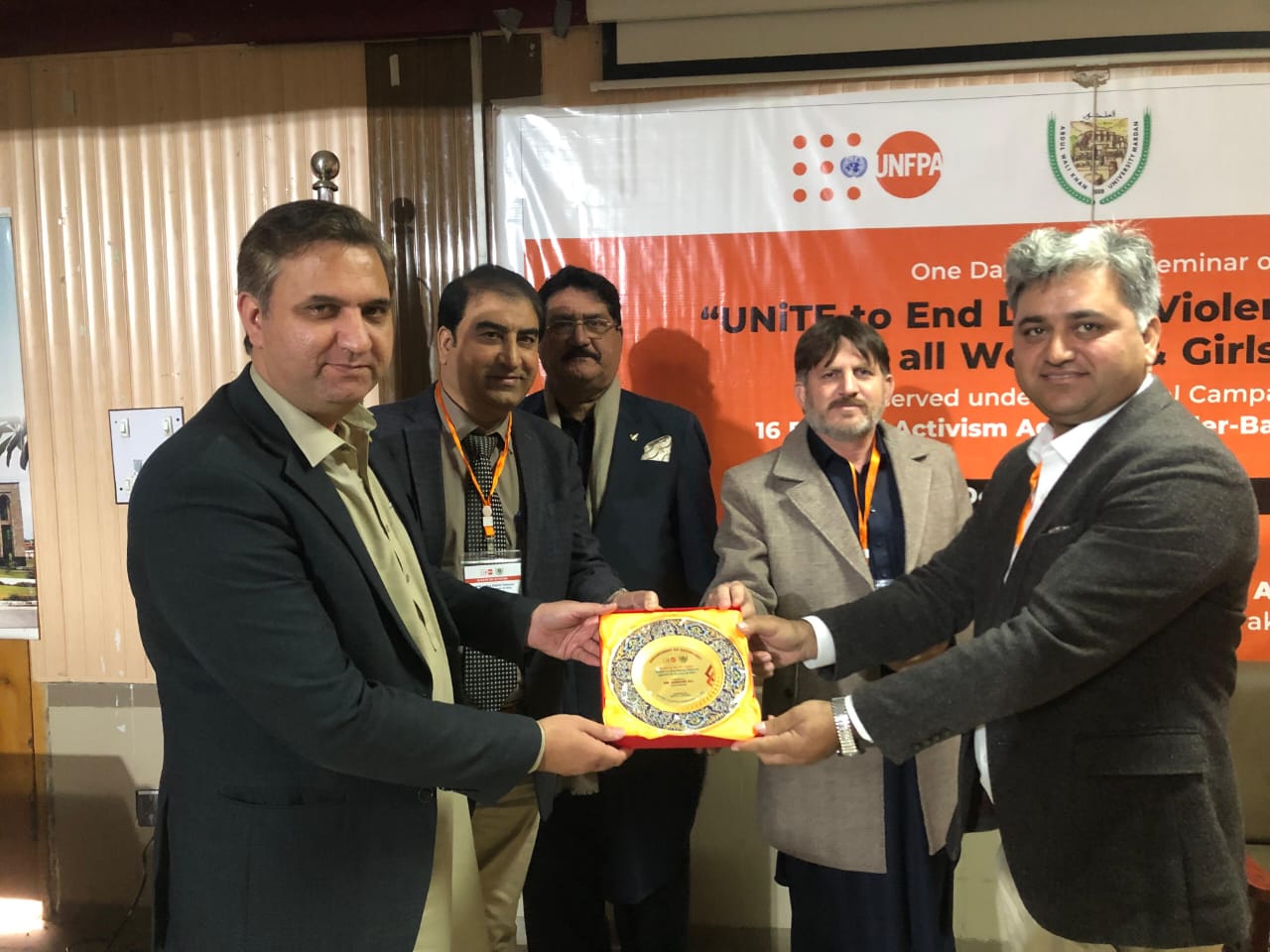
MARDAN:A national seminar titled “UNiTE to End Digital Violence against All Women and Girls” was organized by the Department of Sociology, Abdul Wali Khan University Mardan (AWKUM), in collaboration with the United Nations Population Fund (UNFPA) Pakistan, at the Garden Campus, AWKUM. The event was held to observe the global 16 Days of Activism Against Gender-Based Violence campaign. Dr. Hussain Ali Assistant Professor of Sociology was the chief organizer of the event.
Prof. Dr. Muhammad Azam Khan, Dean Faculty of Business & Economics AWKUM, formally welcomed the distinguished guest speakers and participants as Chief Guest of the seminar. He emphasized that “there is no space for digital or physical violence against women and girls in Pakistan,” and urged efforts toward building a respectful and safe digital culture for all.
Speaking at the seminar, Dr. Riffat Sardar, former Chairperson of the Khyber Pakhtunkhwa Commission on the Status of Women (KPCSW), highlighted the alarming rise of abuse directed at women parliamentarians and working women, both in public spaces and on social media. She described such practices as one of the worst forms of violence against women and girls in the country.
Saima Munier program manager Aurat Foundation expressed concern that violence against women continues to increase, with social media emerging as a major platform for such violations. She stressed that although social media is widely used as an advocacy tool, it remains “silent” when women themselves face abuse or harassment online.
Representing AWAZ-II, Shabina Gulzar, Provincial Team Lead, shared that women, children, and marginalized groups in Khyber Pakhtunkhwa continue to face multiple human rights challenges. She explained that the AWAZ-II programme focuses on the prevention and mitigation of gender-based violence through community engagement and awareness.
Prof. Dr. Minhas Majeed Khan, Chairperson, Department of International Relations, University of Peshawar, and Member KPCSW, stated that gender-based violence is a clear violation of fundamental human rights. She noted that KPCSW plays a leading role in law formulation, policy advocacy, and institutional support to address violence against women and girls in the province.
Speaking on behalf of the Ombudsperson’s Office Khyber Pakhtunkhwa, Dr. Rabia, Human Rights Coordinator and Gender Specialist, highlighted the leadership of Ms. Rubab Mehdi in addressing women’s property rights and protecting women and girls from workplace harassment. She emphasized that the Ombudsperson’s Office provides a vital mechanism for speedy access to justice and improved governance.
During the seminar, Dr. Noor Jehan, Associate Professor of Economics, presented key findings from her research titled “Bridging the Digital Divide: Patriarchy, Gender, and Digital Access in Khyber Pakhtunkhwa.” She argued that patriarchal norms shape who accesses digital spaces, how they use them, and at what cost. She added that patriarchal control restricts women’s digital agency and limits their engagement in the public sphere.
Ikram Ullah Khan, Principal Research Officer, Center of Excellence on Countering Violent Extremism, Government of Khyber Pakhtunkhwa, shared alarming statistics: 1.8 million Pakistani women were victimized in the past five years; 40% of women in Pakistan have experienced cyber harassment; and 80% of complaints received by the FIA Cybercrime Wing come from women and girls.
In his closing remarks, Dr. Ahmad Ali, Chairperson Department of Sociology, expressed gratitude to all guest speakers, panelists, faculty members, and students for their active participation. He appreciated the efforts of Chief Organizer, Dr. Hussain Ali, Assistant Professor of Sociology and student organizer of the seminar, for successfully coordinating the event.
The seminar was attended by Dr. Tariq Mehmud, Director ORIC, faculty members, and a large number of students. The event concluded with the distribution of shields by the Chief Guest among the distinguished speakers.