Kazakhstan’s President Calls for Strategic Trust and UN Reform in Lecture at United Nations University
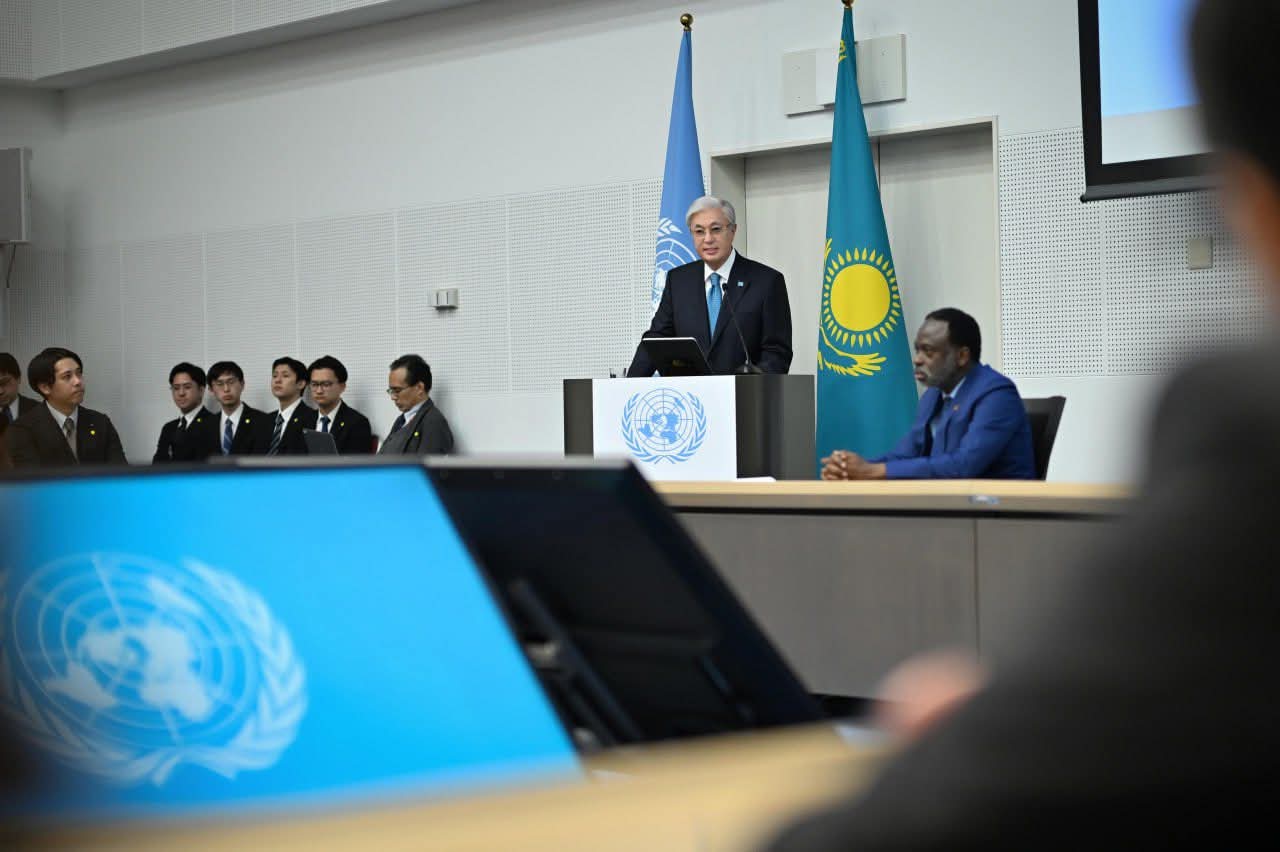
Tokyo — President of Kazakhstan Kassym-Jomart Tokayev delivered a keynote lecture at the United Nations University (UNU) in Tokyo, outlining his vision for restoring strategic trust and strengthening multilateral cooperation amid growing global turbulence.
In his address, titled “Restoring Strategic Trust in an Era of Turbulence: How Kazakhstan Envisions a More Just and Stable World,” President Tokayev became the first head of state from Central Asia to speak at the University. He described the invitation as a sign of confidence in Kazakhstan’s expanding international role and recognition of its commitment to multilateralism and global stability.
The President подчеркнул the personal significance of the United Nations in his career, recalling his previous service as UN Under-Secretary-General, Director-General of the UN Office at Geneva, and Secretary-General of the Conference on Disarmament. He also congratulated UNU on its 50th anniversary, praising the institution’s contribution to developing practical solutions for global challenges.
Drawing parallels between Japanese ethical principles and Kazakhstan’s foreign policy philosophy, President Tokayev cited the 7th-century teachings of Prince Shotoku that place harmony above all else. He noted that harmony, wisdom, and responsible leadership form the core of Kazakhstan’s approach to governance and international relations.
Addressing current global security concerns, President Tokayev warned that the number and intensity of armed conflicts worldwide have reached their highest levels in decades, while global military spending has climbed to a record USD 2.7 trillion. He argued that escalating rivalry among major powers has weakened multilateral mechanisms, particularly limiting the effectiveness of the UN Security Council.
According to the President, rebuilding a culture of strategic trust is essential for restoring predictability and cooperation in international affairs. He emphasized that no country can address today’s complex challenges alone and reaffirmed Kazakhstan’s support for the United Nations as an indispensable platform for collective action.
President Tokayev called for comprehensive reform of the UN, stressing that it is no longer a rhetorical discussion but a strategic necessity. While underscoring the importance of upholding the UN Charter’s core principles—sovereignty, territorial integrity, and peaceful dispute resolution—he noted that some provisions no longer reflect modern realities. He advocated for responsible dialogue on updating the system to enhance its credibility and fairness, including for countries such as Japan that make significant contributions to the Organization.
A key focus of the speech was the reform of the UN Security Council. President Tokayev urged broader participation by responsible middle powers from Asia, Africa, and Latin America, arguing that they can serve as constructive mediators amid great-power rivalries. He said Kazakhstan views this role as central to its balanced, multi-vector foreign policy.
The President also highlighted Kazakhstan’s strategic partnerships with its neighbors—Russia, China, and Central Asian states—while noting expanded engagement with the United States, the European Union, the Middle East, Asia, and the Global South. He described Japan as a particularly important partner and expressed Kazakhstan’s intention to deepen cooperation in trade and investment.
Addressing nuclear security, President Tokayev stated that global security cannot be based on nuclear deterrence. Referring to the tragedies of Hiroshima, Nagasaki, and the Semipalatinsk nuclear test site, he recalled Kazakhstan’s decision to renounce the world’s fourth-largest nuclear arsenal after independence. He called for renewed dialogue among nuclear-weapon states, intensified efforts toward complete nuclear disarmament, and the entry into force of the Comprehensive Nuclear-Test-Ban Treaty. He noted that Kazakhstan and Japan share a unique moral authority to promote progress in this area.
During the visit, a Memorandum of Understanding was signed between the Ministry of Foreign Affairs of Kazakhstan and the United Nations University, marking a new step in strengthening cooperation between Kazakhstan and the UN academic community.