
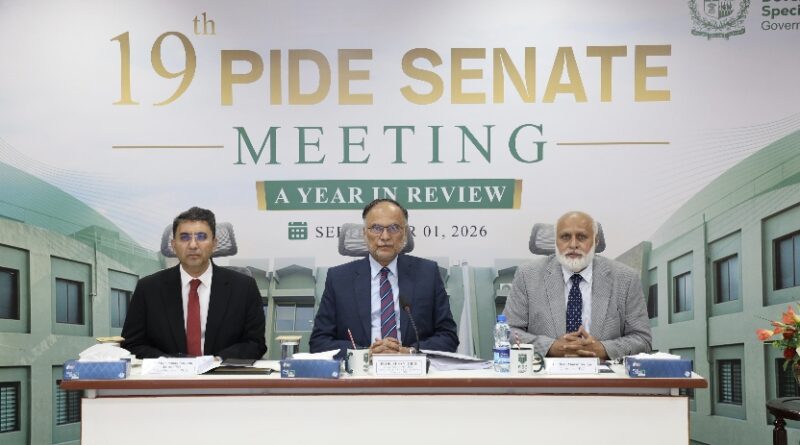
PIDE’s Senate Charts a Bold New Chapter: Landmark Reforms Approved to Power Pakistan’s Development Journey
Islamabad, September 02, 2026 The 19th Meeting of the Senate of the Pakistan Institute of Development Economics (PIDE) approved a sweeping set of institutional reforms at a sitting held in Islamabad, chaired by Prof. Ahsan Iqbal (NI), Federal Minister for Planning, Development & Special Initiatives and Chancellor, PIDE.Proceedings opened with recitation from the Holy Quran, after which the Chancellor, in his opening remarks, spoke of Pakistan’s development trajectory and the need for a holistic, integrated policy framework — bringing together the public sector, private sector, and academia — to achieve sustainable and inclusive growth. He placed particular emphasis on the role of evidence-based policy in building a sustainable export surplus, underscoring that research must be results-oriented and directly useful to policymakers if it is to move the needle on Pakistan’s trade performance.Before turning to the agenda, the Senate paused to place on record its appreciation for the distinguished service of the late Dr. Shamshad Akhtar, a valued member of the Senate, with the House joining in a recitation of Surah Al-Fatiha in her memory. The Chancellor also welcomed two members joining the Senate for the first time — Dr. Iftikhar Ahmed, elected from the faculty, and Ms. Sima Kamil, former Deputy Governor of the State Bank of Pakistan.
The Senate confirmed the minutes and compliance report of its 18th Meeting, noting that eleven of the twelve decisions taken at that sitting stand fully implemented, with the allotment of land for the PIDE campus continuing to be pursued with the concerned authorities.The Senate then received a detailed Progress Review and Compliance Report for 2025-26, presented through a documentary narrated by Vice Chancellor Dr. Muhammad Nadeem Javaid (SI). Reflecting on the year, Dr. Javaid recalled: “When I took on this responsibility, I had one simple belief — that PIDE must matter to Pakistan and its people.” He described the year’s work not as incremental activity but as a strategic reset built on relevance, national purpose, and doing more with the resources available — framed around the Institute’s Institutional Development Strategy 2025–2030 and its central idea of REACH: ensuring that research reaches policy, knowledge reaches government, learning reaches the marketplace, and Pakistani ideas reach wider national and international audiences.Dr. Javaid thanked the Chancellor and the Secretary of Planning for their continued support throughout the year.The report highlighted that PIDE’s RePEc research standing had risen to 102.26, consolidating its position as Pakistan’s leading economic think tank, while research output climbed to 361 products in 2025 — up more than fifty percent from 240 the previous year.
Members were informed of the establishment of eight new research centres, a newly digitised three-year rolling research work plan now tracking the Institute’s research assignments in real time, a threefold increase in academic enrolment, and an 89 percent graduate employment rate within one year of graduation. The Senate warmly endorsed this performance as reflective of PIDE’s growing national and regional stature.In a significant governance development, the Senate approved the results of elections conducted to fill long-vacant faculty seats on the Institute’s statutory bodies, with Dr. Iftikhar Ahmed elected to the Senate and Dr. Madiha Riaz elected to the Syndicate — a step that restores full faculty representation in PIDE’s decision-making forums.Among the most consequential items considered was the approval of eleven institutional policies spanning academic appointments, employee welfare, and student support — developed over the past year under the direction of the Vice Chancellor through a rigorous consultative process involving the Senior Management Committee, institute-wide faculty feedback, and Syndicate review.During deliberations, Senate members engaged in a constructive discussion on how PIDE could draw on the Pakistani academic diaspora — citing scholars based at leading global institutions — through sabbaticals and postdoctoral placements, noting that Pakistan offers researchers a rich and rewarding environment for impactful policy work.The policies as approved formalise arrangements for Professors of Practice, Meritorious Professors, Professor Emeritus designations, Senior Fellows, Postdoctoral Fellows, and Visiting Academic Staff, alongside welfare measures such as fee waivers for employees’ children and merit- and need-based scholarships for students.
A standout addition, the PIDE National Talent Hunt Programme, was introduced as a nationwide initiative to identify and nurture the country’s most promising analytical minds through a rigorous four-stage selection process, offering full tuition waivers, stipends, and mentorship to selected scholars — to be financed through an endowment fund and corporate and alumni partnerships rather than the government grant.The Senate also approved the business model for the newly developed MS in Project Management (MSPM), introduced on the direction of the Vice Chancellor as a self-financing programme designed to build professional project management capacity for Pakistan’s public and development sectors. Drawing on international faculty, top-tier academics, and senior practitioners, the programme is structured to break even at just twelve enrolled scholars.On the appointments front, the Senate approved twenty appointments at the Professor (BPS-21) and Associate Professor / Chief of Research / Director-ORIC (BPS-20) levels, made following a rigorous, multi-stage selection process spanning technical review and interviews conducted over six Selection Board sittings, with candidates benchmarked through evaluations by reviewers based at leading universities in the UK, Australia and Canada.
In closing, the Chancellor directed that members from Azad Jammu & Kashmir and Gilgit-Baltistan be included in the Senate going forward, extending representation on the Institute’s apex governing body to these regions. The Vice Chancellor, in turn, called on provincial representatives present at the meeting to deepen their engagement with PIDE on policy research, inviting each province to work with the Institute on demand-driven research aligned to its own priorities.The Chancellor thanked the Vice Chancellor and the Senate for their guidance and support over the past year, and expressed confidence in PIDE’s continued role in delivering evidence-based policy solutions to help Pakistan achieve its ambitious export growth targets in the years ahead.