US, Iran agree to Pakistan-brokered two-week ceasefire with reopening of Strait of Hormuz
Prime Minister Shehbaz Sharif, early Wednesday morning, announced that Iran and the United States “along with their allies have agreed to an immediate ceasefire everywhere, including Lebanon and elsewhere, EFFECTIVE IMMEDIATELY.”
In a post on X, PM Shehbaz further invited the US and Iran’s “delegations to Islamabad on Friday, April 10 2026, to further negotiate for a conclusive agreement to settle all disputes.”
https://platform.twitter.com/embed/Tweet.html?c
US President Donald Trump agreed to the two-week ceasefire with less than two hours before his deadline for Tehran to reopen the Strait of Hormuz or face devastating attacks on its civilian infrastructure.
Donald J. Trump (@realDonaldTrump)
A big day for World Peace! Iran wants it to happen, they’ve had enough! Likewise, so has everyone else! The United States of America will be helping with the traffic buildup in the Strait of Hormuz. There will be lots of positive action! Big money will be made. Iran can start the reconstruction process. We’ll be loading up with supplies of all kinds, and just “hangin’ around” in order to make sure that everything goes well.
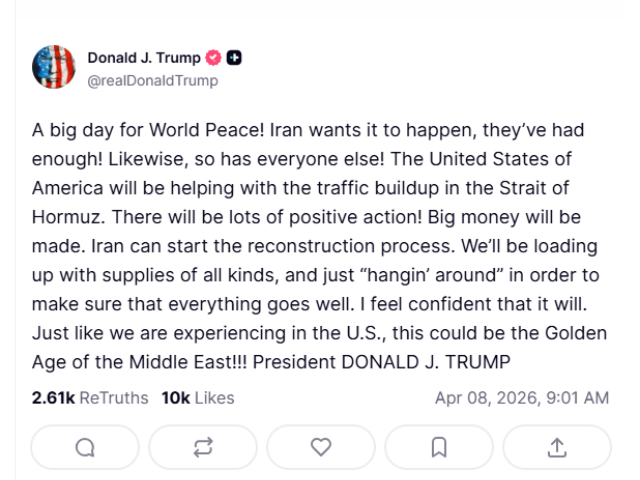
“A big day for World Peace! Iran wants it to happen, they’ve had enough! Likewise, so has everyone else!” he said on Truth Social.
The post added that “The United States of America will be helping with the traffic buildup in the Strait of Hormuz.”
Trump’s announcement on social media represented an abrupt turnaround from earlier in the day, when he issued an extraordinary warning that “a whole civilisation will die tonight” if his demands were not met.
Trump said the last-minute deal was subject to Iran’s agreement to pause its blockade of oil and gas supplies through the strait, which typically handles about one-fifth of global oil shipments. Iran’s Foreign Minister Abbas Araghchi said in a statement that Tehran would stop counter-attacks and provide safe passage through the waterway.
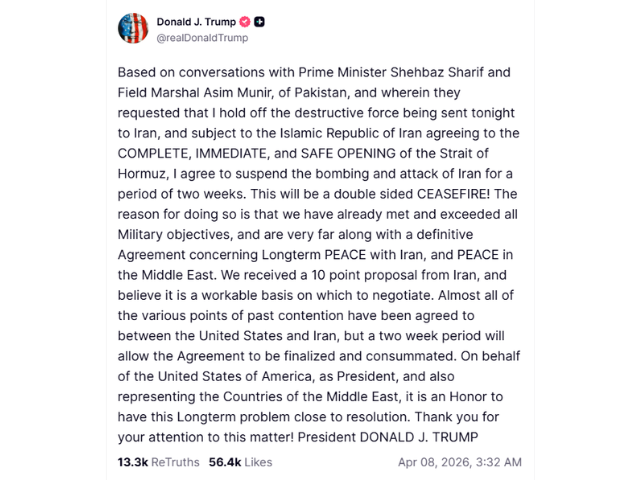
“This will be a double-sided CEASEFIRE!” Trump wrote on his Truth Social platform. “The reason for doing so is that we have already met and exceeded all Military objectives, and are very far along with a definitive Agreement concerning Longterm PEACE with Iran, and PEACE in the Middle East.”
Donald J. Trump (@realDonaldTrump)
Based on conversations with Prime Minister Shehbaz Sharif and Field Marshal Asim Munir, of Pakistan, and wherein they requested that I hold off the destructive force being sent tonight to Iran, and subject to the Islamic Republic of Iran agreeing to the COMPLETE, IMMEDIATE, and SAFE OPENING of the Strait of Hormuz, I agree to suspend the bombing and attack of Iran for a period of two weeks.
White House Press Secretary Karoline Leavitt claimed, “This is a victory for the United States that President Trump and our incredible military made happen.”
“The success of our military created maximum leverage, allowing President Trump and the team to engage in tough negotiations that have now created an opening for a diplomatic solution and long-term peace,” she said in a post on X.
The war, now in its sixth week, has claimed more than 5,000 lives in nearly a dozen countries, including more than 1,600 civilians in Iran and over a 1,000 civilians in Lebanon, according to tallies from government sources and human rights groups.
A source briefed on the talks expressed wariness about the two-week ceasefire holding, saying the US side believed Iran might be trying to buy time. It was a “trust-building exercise,” the source said.
Hezbollah to abide by ceasefire
Hezbollah accepted the two-week ceasefire despite Israel’s continued attacks on Lebanon, three Lebanese sources close to the group told Reuters news agency.
The group halted fire on northern Israel and on Israeli troops in Lebanon in the early hours of Wednesday as part of the US-Iran ceasefire.
According to Al Jazeera, Israel has continued its strikes on southern Lebanon and issued a new evacuation order for one southern city, indicating it would strike there soon, after Israeli Prime Minister Benjamin Netanyahu said the two-week Iran-US ceasefire would not include Lebanon.
Iran’s Ghalibaf, US’s Vance expected at Islamabad talks on Friday
Al Jazeera reported that Parliament Speaker Mohammad Bagher Ghalibaf is set to lead Iran’s negotiating team in Friday’s talks in Islamabad, which is expected to see Vice President JD Vance represent the US delegation, according to Iran’s ISNA news agency.
The report said Iran’s 10-point proposal framework includes not only its nuclear programme and regional security, but also Iran’s primary and secondary sanctions, which date back about 45 years.
Iran expresses gratitude towards Pakistan
Iran expressed gratitude towards Pakistan and claimed victory over the US in multiple posts on X.
The information account for Operation True Promise released a statement thanking Pakistan’s “leadership and its people for the constant and unwavering efforts and support.”
Iran’s Supreme National Security Council said the deal was a victory over the US, saying Trump had accepted Iran’s conditions for ending hostilities.
In a full statement released by the security council, they said, “Nearly all the objectives of the war have been achieved. The noble people of Iran should know that, thanks to the sacrifices of their children and their historic presence on the scene, the enemy has been begging for a ceasefire for over a month.”
“In this regard…and given Iran’s upper hand and that of the Resistance on the battlefield, the enemy’s inability to carry out its threats despite all its claims, and the official acceptance of all the rightful demands of the Iranian people — it was decided that negotiations will be held in Islamabad to finalise the details.”
The security council statement on X said that within 15 days, the details of Iran’s victory would be “cemented in political negotiations.”
In the post, Iran went over key details of the 10-point plan, such as “controlled passage through the Strait of Hormuz in coordination with Iran’s armed forces”, and acknowledged that this would grant Iran a unique economic and geopolitical position.
Additionally, the council spoke about the necessity of “ending the war against all components of the Axis of Resistance (which would mean the historic defeat of the child-killing Israeli regime’s aggression)”, and “the withdrawal of US combat forces from all bases and positions in the region.”
The council emphasised establishing safe transit protocols in the Strait of Hormuz that “guarantee Iran’s dominance according to the agreed protocol”, and full payment of damages to Iran according to estimates,” in addition to “the lifting of all primary and secondary sanctions and resolutions of the Board of Governors and the Security Council.”
The last two points included the “release of all of Iran’s blocked assets and properties abroad”, and the “approval of all these items in a binding UN Security Council resolution.”
Araghchi also shared the SNSC statement on X.
“If attacks on Iran are halted, our Powerful Armed Forces will cease their defensive operations.”
Additionally, Iranian Ambassador to Pakistan Reza Amiri Moghadam also released a statement telling people to “stay more tuned” for the next stage.
https://platform.twitter.com/embed/Tweet.html?creatorScreenName=etribune&dnt=true&embedId=twitter-widget-
UK’s Starmer heads to the Gulf to discuss reopening the Strait of Hormuz
British Prime Minister Keir Starmer will travel to the Gulf on Wednesday to hold talks with partners to ensure the Strait of Hormuz remains open permanently after a US-Iran ceasefire, his office said.
“I welcome the ceasefire agreement reached overnight, which will bring a moment of relief to the region and the world,” Starmer said in a statement.
“Together with our partners, we must do all we can to support and sustain this ceasefire, turn it into a lasting agreement and re-open the Strait of Hormuz.”
Starmer, who has been heavily criticised by US President Donald Trump for failing to support the US and Israeli strikes on Iran, has previously hosted multinational meetings on how allies could support the reopening of the key strait that is fundamental to oil and gas trade.
The British statement said Starmer would discuss diplomatic efforts to “support and uphold the ceasefire to bring about a lasting resolution to the conflict and protect the UK and global economy from further threats”.
The visit to the region had been planned before the ceasefire was announced.
Ceasefire conditioned on Strait’s reopening
Two White House officials confirmed that Israel has also agreed to the two-week ceasefire and to suspend its bombing campaign on Iran. The agreement includes a cessation of Israel’s campaign in Lebanon, PM Shehbaz said.
However, citing Israeli Prime Minister Benjamin Netanyahu, Israeli media states that while Israel “supports Trump’s decision,” the ceasefire “does not include Lebanon”, despite PM Shehbaz’s statements.
Al Jazeera reported that French President Emmanuel Macron welcomed the ceasefire between the US and Iran and said, “It is a very good thing.”
Macron, however, warned that the situation in Lebanon is critical and said the ceasefire deal should include Lebanon.
It was not immediately clear how soon the ceasefire would take full effect. Israeli media reported it would begin once Iran reopened the strait and that Israel expected Iranian attacks to continue in the interim.
Iraq’s Islamic Resistance said it would suspend operations in Iraq and across the region for two weeks.
More than an hour after Trump’s announcement, the Israeli military said it had identified missiles launched from Iran, and explosions from intercepted missiles could be heard in Tel Aviv. Gulf countries, including Kuwait, Bahrain, Saudi Arabia and the United Arab Emirates, also issued near-simultaneous alerts and activated air defences.
Meanwhile, Drop Site News reported that Israel says it will not stop attacking Lebanon.
Israeli media said its military was striking launch sites in Iran.
Trump, who has issued a series of threats in recent weeks only to back away, said progress between the two sides had prompted him to agree to the ceasefire. He said Iran had presented a 10-point proposal that was a “workable basis” for negotiations and that he expected an agreement to be “finalised and consummated” during the two-week window.
Markets breathed a sigh of relief, with US stock futures rising in the minutes following Trump’s message. Oil prices fell sharply, with US crude futures CLc1 touching their lowest price since March 26.
Global leaders also welcomed the ceasefire, with the Australian government saying that “the longer the war goes on, the more significant the impact on the global economy will be, and the greater the human cost”.
Abrupt turnaround
Trump’s announcement capped a whirlwind day that was dominated by his threat to destroy every bridge and power plant in Iran unless Tehran reopened the strait. That unnerved world leaders, rattled global financial and energy markets and drew widespread condemnation, including criticism from the head of the United Nations and Pope Leo.
Some international law experts have said attacking civilian infrastructure indiscriminately could constitute a war crime.
The closure of the strait has sharply increased oil prices, heightening the risk of a global economic downturn or even a recession. The US Energy Information Administration earlier on Tuesday warned that fuel prices could continue to rise for months even after the strait reopened.
With the US midterm election campaign ramping up, Trump’s approval ratings have hit their lowest level ever, leaving his Republican Party at risk of losing its narrow majorities in Congress. Polls show sizable majorities of Americans are opposed to the war and frustrated by the rising cost of gasoline.
As the clock ticked down to Trump’s 8pm EDT (5am PKT) deadline, US and Israeli strikes on Iran had intensified, hitting railway and road bridges, an airport and a petrochemical plant. US forces attacked targets on Kharg Island, home to Iran’s main oil export terminal.