
Pakistan needs strategic clarity and national unity amid transitioning global order: Experts
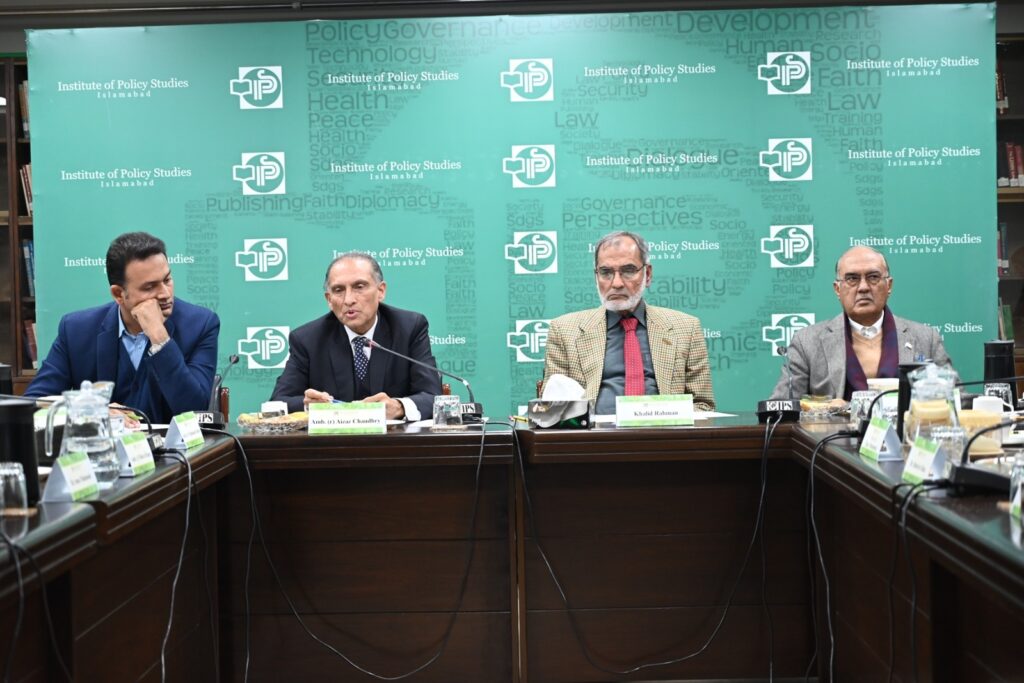
PRESSS RELEASE(NNP) Islamabad, January 29: The contemporary global order is undergoing a significant rupture, marked by the erosion of rule-based multilateralism, the rise of unilateral power politics, and the fragmentation of international norms, posing serious strategic, economic, and societal challenges for states like Pakistan. What was long described as a ‘rules-based order’ often functioned as an instrument of powerful states against weaker ones. Currently, that order is leading to instability, uncertainty, and selective adherence to international law, intensifying the great-power rivalry.This was noted during a session at the Institute of Policy Studies (IPS), Islamabad, titled “The Transitioning World: Implications and Options for Pakistan.” The session brought together former diplomats, academics, and defense and economic experts, including Khalid Rahman, chairman IPS, Ambassador Aizaz Ahmad Chaudhry, former foreign secretary, Dr Khuram Iqbal, associate professor, QAU, Ambassador Naghmana Hashmi, Ambassador Moin ul Haque, Ambassador Masood Khalid, Lt Gen (r) Naeem Khalid Lodhi, former federal minister for national security, Maj Gen (r) Raza Muhammad, former high commissioner to Mauritius, Brig (r) Said Nazir, defense analyst, Prof Dr Shabana Fayyaz, head of department of defense and strategic studies, QAU, Prof Dr Amna Mahmood, head of politics and international relations department, IIUI, Dr Saira Nawaz Abbasi, senior assistant professor, Bahria University, and Dr Shehryar Khan, executive director, NDF.In his keynote speech, Ambassador Aizaz Chaudhry noted that over the decades, multiple centers of power have emerged, forcing the world to transition from multilateralism to multipolarity. This transition is driven by two major factors: unilateralism and hyper-nationalism. The normalization of pre-emptive use of force outside multilateral frameworks and the rise of populist leadership have collectively undermined global stability. This shift has led to widespread insecurity, which is being reflected in increasing armed conflict across the world and accelerating arms accumulation by states seeking security in an increasingly anarchic environment.During the discussion, the speakers identified multiple fault lines shaping the emerging global landscape. Intensifying competition between major powers, particularly in the Asia-Pacific, has turned Asia into the principal theater of strategic rivalry. Similarly, strains of instability within transatlantic relations, evolving dynamics between Russia and NATO, and escalating crises in the Middle East have further destabilized the international system. Likewise, the inability of the collective global legal framework to ensure equality and transparency constitutes a case of global governance failure. Participants noted that the traditional conflict patterns are being supplemented by non-conventional tools of coercion, requiring Pakistan to reassess its strategic preparedness.In this regard, speakers suggested that Pakistan should continue to diversify its foreign policy options. While geopolitics remain critical, internal cohesion, governance capacity, and economic resilience have increasingly become defining components of national power. Similarly, political harmony, societal stability, and state-citizen trust are essential prerequisites for effective diplomacy and long-term strategic autonomy. Participants also suggested that Pakistan should continue to maintain steady, transparent relationships with the great powers, given the broader context of the high-politics competition. Additionally, engagement with middle powers and emerging regions, particularly in Oceania, Northeast Asia, and Southeast Asia, should be increased to expand the country’s diplomatic and economic options. Considering the changing nature of power in the 21st century, the speakers suggested that in addition to military power, Pakistan should pursue technological advancement and innovation by empowering youth and developing indigenous capabilities.Concluding the session, participants agreed that Pakistan is facing a period of deep global instability that simultaneously presents risks and opportunities. Therefore, navigating this environment will require prudence, strategic clarity, and a balance between domestic reforms and external engagement. Similarly, strengthening governance and negotiation capacity, building economic consensus, and fostering national unity were identified as essential steps for safeguarding Pakistan’s interests in an increasingly fragmented world.

jllivhpzkkvdyzujhjnspzkwuqopur
Just signed up for bk999game. Quick process and they loaded my free spins. Ready to go! Go try em out today bk999game.
Yo, just found this epiwingamedownload site. Looks legit, might have to give it a whirl tonight. Fingers crossed it’s not some dodgy scam. Check it out for yourself: epiwingamedownload
Alright dudes, anyone else trying to sign up for j777? That j777loginregister process was a bit clunky, but hopefully worth it for the games! Let me know your experience at j777loginregister