
Chinese automaker empowering consumer choice and innovation
By Chen Junyi, People’s Daily
In a manufacturing facility of Chinese automotive giant Geely in Guanshanhu district, Guiyang, southwest China’s Guizhou province, operations are in full swing. Robotic arms precisely apply adhesives and install windshields, while more than 3,000 employees collaborate with automated systems, assembling vehicles with remarkable efficiency. A new car is produced approximatelyevery 70 seconds.
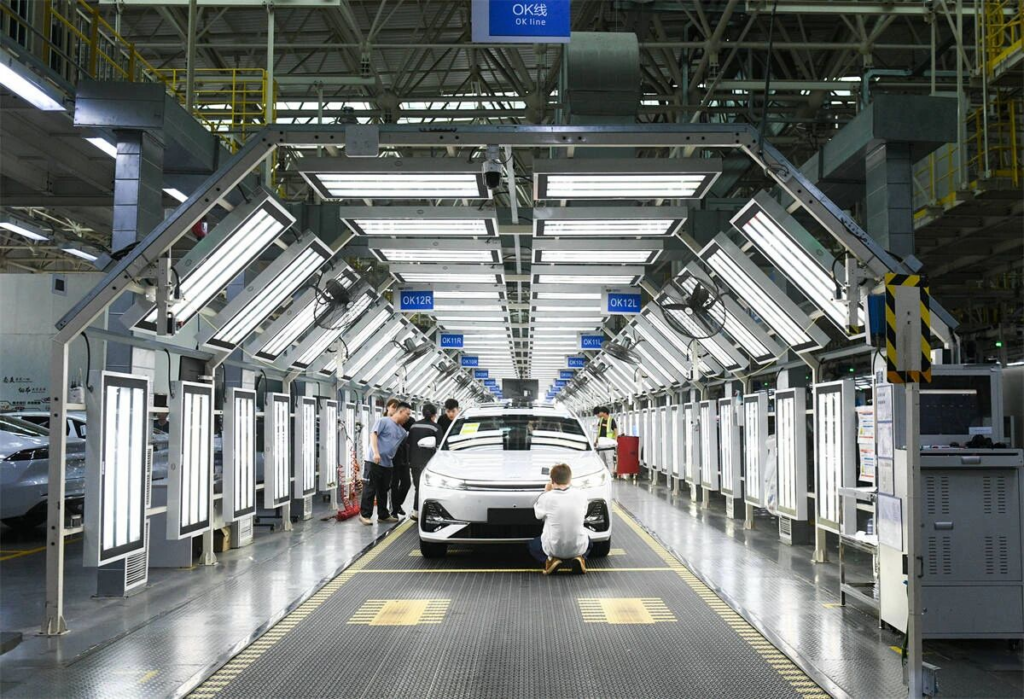
“We’ve been working overtime lately, with 20,000 to 30,000 vehicles pending production,” said Li Feiping, assistant to the general manager, as he highlighted the bustling assembly line.
This surge in production underscores an evolving shift in consumer expectations. At the Geely sales center in Guiyang’s Baiyun district, consumer Zhang Tuying recently purchased a Geely Galaxy E5, impressed by its spacious interior.
“It’ll be comfortable when I start a family. The vehicle’s intelligent system is highly responsive, and the overall value is exceptional,”remarked Zhang.
Zhang’s choice reflects a broader trend in China’s new energy vehicle market. While earlier buyers focused primarily on price and technical specifications such as fast-charging capabilities, battery capacity, and power output, today’sconsumers are increasingly prioritizing factors like cabin comfort, interior space, and advanced technological features.
The shift in consumer demand has prompted automakers to rethink their approach to design and production. “When developing this model, we optimized the chassis and component layout to maximize interior space,” Li said. Since its debut in August 2024, the Galaxy E5 has sold more than 210,000 units.
Developed simultaneously for over 80 global markets, the model has already seen nearly 50,000 units exported this year. “We established a global research and development team to maintain consistent core performance, while tailoring features to meet local preferences,” Li added.
For example, air-conditioning systems have been enhanced for warmer climates, and tires with improved traction have been deployed for regions with more rugged terrain.
The industry’s operating philosophy has shifted from “manufacturers build what they can, and customers select from what’s available” to “manufacturers build what customers truly need.”
Geely has implemented a user-centered evaluation system, in which a third-party team gathers feedback from buyers within three months of their purchase. “We also have after-sales teams that enable customers to share their feedback at anytime,” said Zhang Qianwen, a sales consultant at a Geely sales center.
Feedback is collected through multiple channels, with evaluation teams regularly reviewing customer suggestions for improvements.For instance, some users reported increased motion sickness in electric vehicles, which was traced to rapid acceleration and deceleration.”We adjusted the control algorithms to create smoother, more linear acceleration and braking,”explained Sun Chang, head of quality at the Guiyang manufacturing base of Geely. Minor adjustments can typically be implemented within a month or two, while significant changes are incorporated into model updates or newmodel developments.
A key factor enabling Geely’s rapid response to consumer feedback is the strengthening of the local supply chain. Over the past decade, Geely has attracted 47 supporting enterprises to Guiyang, including seat and sheet-metal producers, increasing the local sourcing rate to 48 percent.
“Seats are large components that incur significant transportation costs. By manufacturing them locally, we can reduce these costs and ensure faster delivery,” said Zhang Feng, head of car seat manufacturer Shuangying Group based in Guiyang. Located just four kilometers from Geely’s plant, the company can configure and deliver seats to the assembly line within an hour of receiving the serial number. “One production line can produce a seat every 60 seconds, with approximately 250 sets delivered daily,”said Zhang Feng.
According to Zhang Nianbing, professor at the School of Materials and Architectural Engineering of Guizhou Normal University, China’s new energy vehicle industry is playing a pivotal role in strengthening the domestic economy by providing smart, sustainable, and high-quality products and services. By aligning supply with evolving demand, automakers are alleviating constraints on effective demand while unlocking market potential, thereby fostering both incremental growth and the vitality of existing markets.